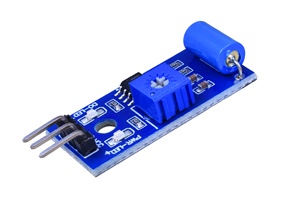
The SW-420 vibration sensor is a module that can detect vibrations or shocks on a surface. It can be used for various purposes, such as detecting door knocks, machine malfunctions, car collisions, or alarm systems. It operates from 3.3 V to 5 V. The module has three peripherals: two LEDs, one for the power status and the other for the sensor output. In addition, there is a potentiometer that can be further used to control the threshold point of the vibration.
Operation
The SW-420 vibration sensor module consists of a SW-420 vibration switch and an LM393 voltage comparator. A SW-420 vibration switch is a device that has a spring and a rod inside a tube. When the switch is exposed to a vibration, the spring touches the rod and closes the circuit. The vibration sensor in the module detects these oscillations and converts them into electrical signals. The LM393 comparator chip then compares these signals with a reference voltage set by the potentiometer. If the amplitude of the signal exceeds this reference voltage, the output of the comparator goes high (1); otherwise, it goes low (0).